Kamis, 31 Oktober 2013

Official: 92 bodies of migrants found in Sahara

africatodayonline.blogspot.com -

DAKAR, Senegal -- The decomposing bodies of 87 migrants from the impoverished West African nation of Niger were discovered in the Sahara this week just a few miles from a well, apparently stranded after a desperate search for water, said the head of a local humanitarian organization who helped bury many of the bodies.


Two trucks carrying the migrants -- men, women and children -- broke down in the northern desert while trying to reach neighboring Algeria, said Almoustapha Alhacen, speaking by phone from Arlit, where they started their journey Sept. 26. Responders found groups of corpses -- 15 here, 11 there -- scattered in a wide radius around a well that the victims had tried to reach. Five other victims were discovered earlier, for a total of 92 dead.


At least 52 of the victims were children, said Mr. Alhacen, who heads a nongovernmental organization called Aghirin Man in Arlit, 120 miles south of the border. One of the trucks broke down less than 10 miles from the well.


Mr. Alhacen described a grim scene. "It was horrible," he said. "Very difficult. They were dehydrated, decomposed. Some of them had been eaten by jackals. You couldn't recognize them. Some had died of thirst."


The victims are thought to have been Nigeriens fleeing one of the world's poorest countries -- Niger ranks last on the U.N. Human Development Index -- in search of opportunity in relatively prosperous Algeria, flush with oil revenue, across the border.


Arlit Mayor Abderrahmane Maouli said migrant deaths in the desert were relatively common. But the scale of the latest disaster was beyond anything the region had yet experienced. "This is the biggest," he said. "We've never seen anything like this."


Migrants pushed back from more prosperous lands in the north congregate in the Nigerien desert city of Agadez, to the south of Arlit, said Ismael Mahamane of the International Organization for Migration in that city; thousands more use Agadez as a staging point.


Niger Justice Minister Marou Amadou, the government spokesman, said: "This is a huge worry for the government. It's growing by the day."


Scattered among the remains were copies of the Quran, as well as the small blackboards that young Quranic students use to copy verses, Mr. Alhacen said. Those details caused officials to speculate that teachers and their students were among the victims -- perhaps would-be mendicants in the regional culture of religious begging.


Out of 113 who plunged into the desert in late September, bypassing the main road and its checkpoints, 21 survived, Mr. Alhacen said. Two, both smugglers, made it back to Arlit and are in jail, he said; 19 reached the Algerian city of Tamanrasset and were sent back.


Cop rot must be stopped at the top

africatodayonline.blogspot.com -

Riah Phiyega has been drawn into the infighting that is consuming upper management at the South African Police Service.


Western Cape commissioner Arno Lamoer and national police commissioner Riah Phiyega. (Sunday Times)


South Africa's most senior police officer, Riah Phiyega, has been drawn into the epidemic of infighting and Machiavellian intrigue that is consuming the leadership of our crime-fighting services.


A Sunday newspaper was played tapes, allegedly of Phiyega briefing Western Cape commissioner Arno Lamoer about a crime intelligence probe into his relationship with a local businessman. This followed a charge of obstructing justice that had been laid against her by suspended acting crime intelligence boss Chris Ngcobo.


If Phiyega's purpose was to shield Lamoer against investigation, that is a serious matter and she must answer for it. But there is a strong suggestion that the moves against her grew out of her "clear out" of rampant malpractice in the police force, and her suspension of Ngcobo days earlier.


Did crime intelligence operatives merely stumble on her conversation with Lamoer, or did something more sinister happen?


The use of the police, intelligence services and National Prosecuting Authority to fight personal, professional and political battles has reached crisis proportions in South Africa, and perhaps poses the single greatest threat to the country's crime-fighting endeavours.


It should be a source of major concern that, according to a senior Western Cape police officer interviewed by the Mail & Guardian this week, crime intelligence in the province has been so disabled by infighting that other arms of the service have been forced to gather their own intelligence.


Interference from the top reared its head under Thabo Mbeki's presidency, when there were increasingly strong signs that he and his loyalists in the prosecutions service were using the corruption investigation against Jacob Zuma to destroy him politically. Mbeki's attempt to shield national police commissioner Jackie Selebi from prosecution, which took place in the bitterly contested build-up to the ANC's Polokwane conference, also seems to have been a reflex of his political ­struggle with his deputy.


But the administration of the new president appears just as prone to politically actuated meddling: how else is one to understand the controversial dropping of corruption charges against Peggy Nkonyeni, one of Zuma's key allies in the pivotal province of KwaZulu-Natal?


Just as troubling has been the escalating abuse of police powers and infrastructure by senior officers to protect and benefit themselves.


Sources tell us that the crime intelligence special services account – intended for special intelligence-gathering operations and the payment of sources – has allegedly been abused by some in the ANC as a political slush fund over many years. More recently, however, the division's senior officers have allegedly taken to raiding it to buy cars and to finance trips abroad.


One might hope that senior policemen who have been caught with their pants down would respect the procedures of the criminal justice system. Their response, however, has apparently been to fight back with every weapon at their disposal, including access to the media and covert surveillance.


There is only one cure for this spreading illness: strict policies to deter the ­misuse of the security services for personal or political advantage.


It is a change that must start at the top. Richard Mdluli's masterstroke was to present himself as an ally of President Zuma, a conspiratorially minded politician who appears susceptible to the tittle-tattle of self-serving intriguers.


The making of Abdul Majeed Waris

africatodayonline.blogspot.com -

Sports Features of Tuesday, 29 October 2013


Source: Tetteh, Nii Ayitey


By Nii Ayitey Tetteh


As his mates had dinner, Captain of the Black Stars, Asamoah Gyan and his ever willing and conniving team mate, Derek Boateng, reportedly conspired to officially induct him into the national team. As was becoming the tradition; new players are made to do a routine in presence of the entire team to signal their acceptance into the team.


Abdul Majeed Waris, then playing for Swedish club BK Häcken, was not going to be treated differently. He was made to do a dance routine; yes, you guessed right; he was made to do the ‘Azonto’. Waris’ movement on the night was directly opposite his movement on the football pitch; off beat. That was in 2012 when Waris made his debut for the Black Stars ; a year down the line, Waris will perhaps not look back on that night as one of humiliation, but rather one of exposure; one that put him in the public eye; a night of illumination. In that intervening period, Waris has endured a one big snub and then a recall that has seen him score 3 times consecutively in the Black Stars 2014 World Cup Qualifiers. Today, if you asked many to name their Black Stars’ first eleven, Waris will be one of the first names on the Black Stars team sheet. That’s how quickly Waris has danced his way into becoming a key player for the Stars; that journey however didn’t begin last year, it began in 1991.


SMALL BEGINNINGS


19th September 1991, was when Abdul Majeed Waris was born in Tamale, Northern Region, Ghana. He would move further south to the Eastern Region and specifically to ‘Right To Dream’, a soccer academy where he honed his raw skills. In 2008, Waris benefited from the Academy’s partnership with Hartpury College and moved to the United Kingdom. In his first season, Waris scored 36 goals in only 21 appearances for Hartpury, including hat tricks in the semi-final and final of the U18 Colleges’ Cup. That was enough to convince scouts of Swedish Premier League club BK Hacken, who signed him on a 4 year professional contract in 2009. However, he had to wait till March 2010 when he made his debut.


Waris will go on to make a total of 55 appearances, scoring 26 goals for BK Hacken. Interestingly, 23 of those goals were scored in the 2012 season, where Waris also amazingly scored 5 goals in one single game against IFK Norrköping; becoming the first player in the Swedish top fight and the first Ghanaian to score 5 goals in a single match in Europe. He did not only win the Goal King for that season, he was also voted 2012 Sweden Premier League Player of Year. His rising stock caught the attention of Russian giants, Spartak Moscow, and in November 2012, Waris transferred for an undisclosed fee.


Naturally, it was expected that Waris will make Ghana’s squad for the 2013 Africa Cup Nations in South Africa, but he was surprisingly snubbed by Coach Kwesi Appiah. Waris’ disappointments didn’t ease as he picked an injury which delayed his Spartak debut till March 10, 2013, when he came on as an 82nd minute substitute in Spartak's 3–1 win over FC Terek Grozny. Indeed, that month was a month of second chances, as he was re-invited to join the Black Stars in preparation for a World Cup qualifier against Sudan.


RISING PROFILE


On March 24, 2013 at the Baba Yara Stadium in Kumasi, Waris made his full international debut for the Black Stars as the lead striker against Sudan. Once this wasn’t an ‘Azonto’ dance routine, Waris had no problem dancing around Sudan’s defenders. He capped a fine afternoon with his debut goal while also making an assist as Ghana beat Sudan 4-0. His pace, movement was so good; Coach Kwesi Appiah surely recognized his mistake in leaving him out of the Nations Cup squad. Since then, Waris’ profile with the Black Stars has been on the up and up. His position in the national team now affords Captain Asamoah Gyan, who used to lead the line alone, the freedom to play behind Waris and even drop deeper to the middle or the lines to create channels for other players to run into.


Indeed, both players’ style seem to complete each other; while Gyan emphasizes guile and technique, Waris’ direct running, sharp instincts and incredible ability to out jump taller defenders (Waris stands at 5ft 7.5 inches) have Ghanaians drooling at a strike partnership that will guarantee goals. On October 15, 2013 when Ghana thrashed Egypt 6-1 in the first leg of the final 2014 World Cup play off with Waris on the score sheet, Ghanaian fans and pundits weren’t only convinced about Ghana’s seat at 2014 World Cup in Brazil; there was another conviction; Abdul Majeed Waris had come to stay! It might have come a year late but he had won Ghanaians over; similarly the Azonto steps will come with time.


niiayitey29@gmail.com


follow me on twitter @niithesoccerguy


(Culled from the 90 Minutes)


Comments:

This article has 43 comments, give your comment


Congo rebels retreat, but unclear if rebellion near end- U.S. envoy

africatodayonline.blogspot.com -

By Lesley Wroughton


WASHINGTON (Reuters) - Recent military advances by U.N.-backed Congolese troops in crushing a 20-month rebellion in the east are a major step, but it is too soon to say if the M23 rebels are on the brink of defeat, a senior U.S. official said on Thursday.


In an interview with Reuters, Russ Feingold, U.S. special envoy for the Great Lakes region of Africa, said a peace deal between the Democratic Republic of Congo and rebels from the M23 group may be reached as soon as this weekend.


But he cautioned that a peace pact would not end the decades of instability in the region until the root causes of the conflict, including ethnic tensions, are resolved.


"There is every reason to believe that the parties are getting ready to finalize the agreement," the former U.S. senator said.


"It may have happened even without this fighting because we have made a lot of progress, but clearly the M23 is in a tougher position at this point," he said, adding, "It may well be that this weekend at least an initial signing and initialling will occur and perhaps disbanding of the M23 is imminent."


Millions of people have died from violence, disease and hunger since the 1990s as foreign-backed ethnic rebel groups have fought for control of eastern Congo's rich deposits of gold, diamonds and tin.


Congolese troops were hunting rebels deep in the forests and mountains along the border with Rwanda and Uganda on Thursday after the insurgents fled their stronghold in the eastern border town of Bunagana.


Peace talks between the government and M23 rebels resumed in Uganda on Wednesday after falling apart last week, just as the Congolese army was gaining more ground, supported by a beefed-up U.N. intervention brigade.


Feingold said it would be "a bit speculative at this point" to say whether the M23 retreat meant the rebellion was over or that the insurgents were regrouping.


"What we have seen here is a fairly measured, reasonable approach by both the Congolese government, and the Congolese military, and frankly it may well be that the M23 is not being assisted," he said.


"We don't know yet whether their sources of help in the past are diminished or gone, or whether this is possibly a tactical or strategic move by the M23 to come back later," he added.


While the Congo army's confidence had been lifted by the recent successes, Feingold cautioned government forces not to repeat abuses of the past against civilians that could ignite new conflicts.


"So much of this good news for the Congolese government, for its military, could be undone if that happens, but it's a golden opportunity for the credibility not only for the military but also for the nation," Feingold said.


He added, "Restraint does not mean not acting against illegal groups. It means don't overdo it (and) push this in a way that leads to greater conflict."


'RECURRENT STORY'


Feingold, who attended peace talks in Uganda last week along with other international envoys, said it was clear during the talks that Congolese officials were eager to seal an agreement, while M23 negotiators did not have the authority from commanders in the field to finalize a deal.


He acknowledged that a peace deal would build confidence but that lasting peace would not be forthcoming until the Congolese government controlled the entire country, including eastern Congo, and deep-seated ethnic tensions were addressed.


"It is not enough to get rid of the armed groups. This has been a recurrent story where groups like this go away and reconstitute themselves under another name," Feingold said.


He said the process had been helped by a sustained focus of the international community in ensuring all sides honour their commitments.


"The international community is demonstrating sustained attention that makes the good actors in the region realize we're there to support them and the bad actors realize we are not going away," he said. "That is an unusual dynamic that is assisting an African-led effort to solve this problems."


The appointment in July of Feingold, a liberal Democrat who served as chairman of a Senate subcommittee on Africa, signalled that the United States saw Congo as one of its foreign policy priorities after years of pressure from advocacy groups.


In July, Washington warned ally Rwanda to end its support for M23 rebels and to stay out of the conflict. It was careful not to directly implicate Rwandan President Paul Kagame, whose poverty-fighting development programs are widely praised.


Feingold described Kagame as "one of the most effective leaders of recent decades" in rebuilding a country from genocide.


"It is my sense that he does not like the reputational damage that has come from people saying that his country has given support to an illegal armed group," Feingold said. "It doesn't fit the positive narrative he is building for his country.


"It is something that he does not want to have to deal with. So whatever the exact facts on the ground - we have our view of what those facts are and he has his - it is not in the interest of Mr. Kagame or Rwanda to have to face those kinds of accusations. I am hoping that Rwanda has decided being tainted by the M23 is not in its interests."


(Reporting by Lesley Wroughton; Editing by Peter Cooney)


Bodies of 92 migrants found in Sahara Desert

africatodayonline.blogspot.com -

Dakar, Senegal -- The decomposing bodies of 87 migrants from the impoverished West African nation of Niger were discovered in the Sahara Desert this week just a few miles from a well, apparently stranded after a desperate search for water, said the head of a local humanitarian organization who helped bury many of the bodies.


Two trucks carrying the migrants - men, women and children - broke down in the northern desert while trying to reach neighboring Algeria, said Almoustapha Alhacen, speaking by telephone from Arlit, where they started their journey Sept. 26. Responders found groups of corpses - 15 here, 11 there - scattered in a wide radius around a well that the victims had tried to reach. Five other victims were discovered earlier, for a total of 92 dead.


At least 52 of the victims were children, said Alhacen, who heads a nongovernmental organization called Aghirin Man in Arlit, 120 miles south of the border. One of the trucks broke down less than 10 miles from the well. The mayor of Arlit, Abderrahmane Maouli, said by telephone, "Between the vehicle and the well, they were scattered here and there, a bit everywhere."


Alhacen described a grim scene.


"It was horrible," he said. "Very difficult. They were dehydrated, decomposed. Some of them had been eaten by jackals. You couldn't recognize them. Some had died of thirst."


The victims are thought to have been Nigeriens fleeing one of the world's poorest countries - Niger ranks last on the U.N. Human Development Index - in search of opportunity in relatively prosperous Algeria, flush with oil revenue, across the border.


Maouli said migrant deaths in the desert were relatively common. But the scale of the latest disaster was beyond anything the region had yet experienced.


Migrants pushed back from more prosperous lands in the north congregate in the Nigerien desert city of Agadez to the south of Arlit, said Ismael Mahamane of the International Organization for Migration in that city; thousands more use Agadez as a staging point.


Out of 113 who plunged into the desert in late September, bypassing the main road and its checkpoints, 21 survived, Alhacen said. Two, both smugglers, made it back to Arlit and are in jail, he said; 19 reached the Algerian city of Tamanrasset and were sent back.


Tiger Resources raising up to $50m

africatodayonline.blogspot.com -

Tiger Resources has tapped investors for up to $50 million to help fund its Democratic Republic of Congo copper project.


The West Perth-based company said it placed $34 million at 34 cents a share with institutional, sophisticated and professional investors, and had agreed to raise a further $8.5 million from a long-only investment fund.


Up to $8 million will be raised from existing shareholders through a share purchase plan at the same issue price.


Tiger said the funds would provide additional flexibility to bank overdraft facilities and augment working capital.


They could also contribute to reserve payments to Tiger's joint-venture partner in the Kipoi copper project and to vendors of Tiger's interest in the mine.


Tiger's shares were down 3.8 cents, or about 10 per cent, to 35.7 cents at 9.30am.


Cannaccord Genuity (Australia) acted as lead manager and bookrunner to the share offer.


10 Things to Know for Friday

africatodayonline.blogspot.com -

Your daily look at late-breaking news, upcoming events and the stories that will be talked about Friday:


1. GOOD NEWS FOR TRAVELERS WHO DISLIKE BEING DISCONNECTED


The FAA is easing restrictions on the use of electronic gadgets on airplanes — though chatting on cellphones will still be prohibited.


2. ISRAELIS TARGET WEAPONS SHIPMENT IN SYRIA


Warplanes attack a store of Russian missiles in the port city of Latakia, an official says. It's an apparent continuation of Israel's campaign to keep arms from proliferating in the Mideast.


3. STOP-AND-FRISK GETS A REPRIEVE


A federal appeals court blocks a judge's ruling that the NYPD's controversial tactic discriminates against minorities.


4. DEATH IN THE DESERT


Nearly 100 African migrants hoping to travel to Algeria die of thirst after their two trucks break down in the middle of the Sahara.


5. FOUR DAYS, FOUR MASS KILLINGS


Experts say violence that left 14 adults and seven children dead is nothing more than random chance, not a sign of growing violence in America.


6. HOW WALL STREET AVOIDED OCTOBER JINX


Rather than being rattled by the U.S. government shutdown, investors kept their focus on what probably matters more: the Federal Reserve.


7. DRIVER TICKETED WHILE WEARING GOOGLE GLASS


The California woman plans to challenge what may be a first-of-its-kind citation, saying the Internet-connected eyewear makes navigation easier.


8. WHAT MAY PROVE DAMAGING TO TORONTO MAYOR


Police say they have a video that appears to show Mayor Rob Ford smoking a crack pipe.


9. IN GEOPOLITICS, IT'S SPY VS. SPY


Even close allies keep things from one another — and work every angle to find out what's being held back.


10. WHO'S CONDUCTING A WORLDWIDE POLL


The Vatican wants to know how Catholic parishes around the globe handle sensitive issues like contraception, divorce and gay couples.


Human Rights Working Group Makes Statement on Death of Somalian Journalist

africatodayonline.blogspot.com -


Shabelle Media Network (Mogadishu)


Somalia: Press Release By the Human Rights Working Group On the Assassination of Universal Reporter and Closure of Shabelle


29 OCTOBER 2013


The Human Rights Working Group (HRWG), a group of international partners comprising the European Union, Norway, Switzerland and the United States, sharply condemns the assassination of Universal TV reporter Mohamed Mohamud Tima'adde, who succumbed to his injuries on the evening of 26 October. The HRWG expresses its sincere condolences to the family and friends of Mohamed Mohamud Tima'adde.


The HRWG is also concerned about the forced closure of the Radio Shabelle outlet in Mogadishu by government's forces, and the arrest of Radio Shabelle staff and reporters. A free, independent, and vibrant press is indispensable to any democratic society.


The HRWG urges the parties to find a peaceful solution and calls on the Federal Government of Somalia to allow all journalists to work without fear of censorship or being subject to intimidation. Fundamental rights and freedoms warrant protection - including the freedom of expression and of the press.


The HRWG notes with regret that these series of targeted attacks and harassment against journalists highlight the continuing threat to media workers . The HRWG calls upon the Federal Government of Somalia to take immediate action to improve the protection of media workers; to operationalise the announced Task Force on the Investigation of the Killings of Journalists; and to bring the perpetrators of these crimes to justice.


Background:


The European Union and its Member States established a Human Rights Working Group on Somalia (HRWG) in December 2011, together with Norway, Switzerland and the United States. Respect for and promotion of human rights is at the foundation of the participating members of the Human Rights Working Group (HRWG), and an inherent part of their development policies.


Scores die of starvation, thirst in Niger's desert on smuggling route

africatodayonline.blogspot.com -

It’s a long, arduous and well-worn route. Hopeful Africans travel north through Niger, Mali and Algeria, crossing the Sahara desert to reach Europe, find work and send money home to their families.


The exodus often goes nightmarishly wrong for the migrants. They must trust their lives to unscrupulous smugglers. If someone hasn’t been paid along the route, they are sometimes abandoned by their driver. If a vehicle breaks down in the desert, there is no guarantee that help will ever come.


In the latest tragedy, 92 bodies were found in the desert of Niger, according to a Nigerian humanitarian worker, after the migrants’ two trucks broke down near the Algerian border. The bodies were strewn across the desert, found where they fell in their death march to try to reach help. Most were women and children.


The whereabouts of their drivers was not known, according to authorities.


“It was horrific,” Almoustapha Alhacen, a rescuer from a humanitarian organization, told the Associated Press. “We found the bodies of small children who were huddled beside their dead mothers.”


The dead included 52 children, 33 women and seven men, he said. Some children were found alone.


Alhacen told Reuters news service that travelers are usually young men, not women traveling with children.


“It’s the first time I’ve seen anything like it. It is hard to understand what these women and children were doing there,” he said.


The first truck reportedly broke down north of Arlit as it approached the Algerian border. The second truck returned to Arlit for a spare part, leaving the travelers in the desert. It too broke down before reaching the town.


It’s believed that the migrants waited for the truck to return for about five days and then set out looking for help or a water well.


Authorities found out about the breakdown only after two survivors staggered out of the desert and arrived in Arlit days later.


The bodies were scattered over a wide area with a 12-mile radius, suggesting that many of the migrants became lost trying to walk to the Algerian border, which was just six miles away from where the migrants were abandoned.


Zim elections report: One step forward, two steps back

africatodayonline.blogspot.com -

President Jacob Zuma may appeal an order forcing him to hand over a report on the 2002 Zim elections to the M&G.


Judge Sisi Khampepe's findings on the Zimbabwe elections will remain out of the public eye for the time being. (Oupa Nkosi, M&G)


Pretoria high court Judge Takalani Raulinga on Thursday granted President Jacob Zuma leave to appeal an earlier order he made that the government furnish the Mail & Guardian with a report on the 2002 Zimbabwe national elections.


Raulinga ordered that the appeal be heard by the Supreme Court of Appeal, rather than by a full bench of the high court. The state had argued for the latter, after noting the "vicious circle" the matter had travelled since it began four years ago, when the M&G made its initial Promotion of Access to Information Act application to access the report compiled by justices Sisi Khampepe and Dikgang Moseneke.


The matter has travelled from the high court to the Constitutional Court and then back again, after the Constitutional Court ruled that the high court might have a "judicial peek" at the report before making a ruling.


In his latest ruling, Raulinga held that since the superior courts had not seen the report, "it was therefore critical that leave to appeal be granted so that another court may have sight of the report".


He reiterated findings in his previous judgment that stated that "the report potentially discloses evidence of a substantial contravention of, or failure to comply with, the law and therefore the public interest supersedes the harm that may occur should the report be released".


The M&G reported earlier this year that Zanu-PF insiders were concerned that the release of the report would open a rift in the party because it could show that senior party officials close to Zimbabwean President Robert Mugabe had harboured reservations about the handling of the elections.


The report was submitted to then-president Thabo Mbeki and apparently formed part of the basis on which South Africa deemed the Zimbabwean elections to have been free and fair.


The report could shed light on whether Zanu-PF officials sanctioned political violence during the elections and if party leaders had been involved in the decision-making.


The M&G's lawyer, Dario Milo, said the application for leave to appeal "should have been refused as "the state has no reasonable prospects of success". He said it seemed likely that the matter would eventually end up in the Constitutional Court again, "by which time it will have been through five courts".


Niren Tolsi is a senior journalist with the Mail & Guardian.


Phillip de Wet is an associate editor at the Mail & Guardian.


Gauteng ANC springs nomination surprises

africatodayonline.blogspot.com -

Branches in Gauteng want Vavi and Jim to be included on the list of those who will represent the ANC in Parliament after next year's elections.


Gauteng provincial secretary David Makhura is likely to replace Premier Nomvula Mokonyane. (Madelene Cronjé, M&G)


Zwelinzima Vavi, the suspended boss of the trade union federation Cosatu, and Irvin Jim, the general secretary of the National Union of Metalworkers of South Africa (Numsa), might have fallen out of favour with the ANC top brass at party headquarters at Luthuli House, but branches in Gauteng want them to be included on the list of those who will represent the ANC in Parliament after next year's elections.


The province - which has been at loggerheads with supporters of President Jacob Zuma because of the perceived hostility by some provincial leaders towards the ANC president - has also nominated ­former president Thabo Mbeki for the national list.


But Gauteng ANC branches have also overwhelmingly nominated Zuma to serve for a second term as the country's president after the elections. Cyril Ramaphosa is nominated at number two after Zuma and Sports Minister Fikile Mbalula's popularity is also evident - he was nominated at number three.


Gauteng did not support Mbalula's failed attempt to replace Gwede Mantashe as the ANC secretary general at the ANC's elective conference last December. But branches in Gauteng and other provinces want him to continue to serve as a member of Zuma's Cabinet.


It is unlikely that Vavi and Jim would accept a nomination to serve in the National Assembly, as they believe this would compromise their independence as union leaders. They declined nominations to serve on the ANC's national executive committee in December last year.


However, Cosatu president Sdumo Dlamini and the general secretary of the National Education, Health, and Allied Workers' Union, Fikile Majola, who have been nominated by ANC branches in Gauteng, are likely to accept nomination, as they believe that having more communists in government and the Cabinet serves the interests of the working class. Dlamini and Majola were elected ANC NEC members last year.


Mbeki is unlikely to accept the nomination.


ANC provincial secretary David Makhura is number one on the province-to-province list, meaning he will probably replace Nomvula Mokonyane as Gauteng premier. It appears the majority of ANC branches want her to serve at a national level.


The Gauteng national-to-national list also features former Gauteng mayor Amos Masondo, former Reserve Bank governor Tito Mbo­weni, former police commissioner Bheki Cele, former local government MEC Humphrey Mmemezi, former communications minister Siphiwe Nyanda, Zuma's spokesperson Mac Maharaj, and former ANC Youth League leaders Zizi Kodwa and Pule Mabe.


In North West, the one thing opposing ANC factions agree on is that Zuma must serve a second term.


Lobbying lists that were thrashed out at its conference on Thursday show that, despite a fall-out in the Zuma camp, no faction wants to be at odds with the ANC's national leadership by demoting Number One to a lesser position.


However, the divisions in the provincial leadership in North West are deep and clear.


On the list of a bigger North West faction, provincial chairperson Supra Mahumapelo sits at the top for a possible premier position, while the current premier, Thandi Modise, is at number 27.


However, an opposing provincial list, headlined "inclusive and non-factional", retains Modise in the province's top spot. Deputy President Kgalema Motlanthe also gets resuscitated by this faction, which wanted him to take over as ANC president last year. His name also features high on the Gauteng list. Even former human settlements minister Tokyo Sexwale will make a comeback as an MP if this group gets its way.


In a sign of some level of inclusiveness, Gordon Kegakilwe, who is this weekend standing against Mahumapelo for the position of North West provincial secretary, also made it to the top 10.


So did social development MEC Collen Maine, the provincial convener of the youth league's task team.


South African Communist Party provincial secretary Madoda Sambatha's inclusion higher up will appease the communists and Cosatu. Sambatha's name also features prominently on the Gauteng list.


The ANC Women's League provincial co-ordinator, Susan Tsebe, also made the list and former public works MEC Mahlakeng Mahlakeng is likely to make a comeback as one of the province's legislators.


The chairperson of the provincial standing committee on public accounts, Hlomane Chauke, who has ruffled feathers since he began heading the committee last year, appears on both the provincial legislature and national assembly lists, but stands a better chance of being sent to Parliament.


ANC sources said putting Chauke higher up on the National Assembly list - in fourth position - was intentional because the plan is to remove him from the province.


All provinces were required to hold their list conferences by Thursday this week. The ANC will hold a national list conference this month to consolidate the lists from the nine provinces, in preparation for a full-blown election campaign.


Matuma Letsoalo is a senior politics reporter at the Mail & Guardian.


Mmanaledi Mataboge is senior politics reporter for the Mail & Guardian.


My colleagues betrayed me - Salami

africatodayonline.blogspot.com -

By Ikechukwu Nnochiri


ABUJA — Retired President of the Court of Appeal, Justice Isa Ayo Salami, yesterday, likened himself to the biblical Joseph, saying he was betrayed and sold out by most of his hitherto trusted friends and colleagues on the Bench.


Salami who spoke at a valedictory court session that was organized in his honour by the Court of Appeal in Abuja, said he was a victim of executive witch-hunt, stressing that the National Judicial Council, NJC, played into the hands of desperate politicians that wanted his ouster by all means.


He maintained that the NJC, by its actions and conduct with regards to all the issues that culminated to his suspension on August 18, 2010, grossly failed in its duties and functions as a revered arm of the Nigerian judiciary.


JUSTICE ISA AYO-SALAMI.

*Justice ISA AYO-SALAMI.


Justice Salami argued that not only was the NJC wrong in suspending him even though it lacked the constitutional powers to do so, he said the legal body also acted wrongly when it asked President Goodluck Jonathan to okay his removal from office.


He wondered why the NJC which is created by the Constitution to protect judicial officers (judges), abandoned its responsibilities and sold out in his case.


“The last three years of my career were dogged by travails which are not dissimilar to the fate of Joseph in the book of Genesis in the Bible.


“As his brothers conspired to destroy him by throwing him into a well and selling him into slavery, my learned brothers and friends in the legal profession planned and executed same evil to me.


“The National Judicial Council, NJC, created by the Constitution to protect me, nay any judicial officer, was on the vanguard of my travails. The NJC failed in its duties and thereby surrendered its functions to the Executive arm of government thus, ingratiate itself to the Executive.


“For instance, the NJC having cleared me of any wrongdoing, following the recommendations of Justice Aloma Mukhtar’s committee, ought to have recalled me to office without asking the President to exercise the power that he does not possess, on the flimsy excuse that it had earlier referred the matter to him.”


“In truth, as a matter of courtesy, all it needed to do was to write the President that in view of its recent decision, this matter was now outside his purview. After so informing him, NJC would be free to take the necessary step to implement its decision.


“The position in which NJC has found itself is similar to that of the proverbial cock that betrayed itself to the fox that what was on his head was not fire and encouraged the fox to touch it.”


Yuguda's battles against Baraje's men in Bauchi

africatodayonline.blogspot.com -

By Suzan Edeh


The crisis in the PDP came into the open at the last national convention in Abuja when seven of the governors of the party and former Vice-President Atiku Abubakar staged a walkout to form a parallel national executive of the party.

While the uprising has spread across to many states of the federation and remained unresolved at the national level, in Bauchi State it has remained a simmering issue unable to burst out or permanently evaporate.

The opposition to the new PDP as led by the Alhaji Kawu Baraje was recently underlined by Governor Yuguda when he said:

“I wonder what they are actually talking about because PDP is a united family and people who leave the party to form factions are not the real card-carrying members of the party”.


It was thus not surprising that a recent stakeholders’ meeting called by elements of the nPDP in Bauchi was aborted by the police who blocked off entry into the Awalah Hotel venue of the meeting.

The Protem Chairman of the new PDP in Bauchi, Alhaji Mohammed Isa said that the Police prevented them from going into the venue of the meeting despite the prior notice given to the police for the meeting.


“Our executives were invited by the state police commissioner and after our discussions with him, he granted our request to hold our consultative meeting and pledged to deploy policemen to protect us and warned us not to do anything that will lead to the breach of peace,” Lawal said.

It was as such surprising for Lawal that the police would turn round to frustrate the meeting based on instructions reportedly from above.

“When party members, stakeholders and other elders of the party, started coming to the venue of the meeting, a team of armed mobile policemen led by the commissioner of police, came and cordoned the Awalah Hotel venue of our meeting. When the Police Commissioner saw me, he told me that he was acting on orders from above that the meeting should not hold”.


“We are disappointed because we followed all rules and regulations to hold this meeting. We are Nigerians and have the right under democratic dispensation to meet with our supporters to discuss matters that affect us, but to our dismay they have now infringed on our fundamental rights to meet and to discuss”, he claimed.

He advised their supporters to be law abiding, to be patient and to wait for further directives in order to hold the meeting with a view to give direction to the party in the state.


Reacting to the incidence, Bauchi State Police Command Public Relations Officer, DSP Haruna Mohammed said: “I am not aware that New PDP had applied to hold a meeting in Bauchi, and I am not aware that police stopped them, but I will enquire about it and get back to you with the necessary information.”

Analysts in the state are not surprised and say the development underlines the determination of the state PDP machine to show its unalloyed loyalty to the Tukur regime.


“We have only one PDP and there is no way you can divide it into two unless you want to tamper with the constitution of the party. Creating a faction in the PDP is unconstitutional because when you become card-carrying member of the party, you swear an oath to be loyal and abide by the constitution of the party,” PDP State Assistant Publicity Secretary, Alhaji Bashir Bukar Rimin told newsmen recently.

“So it is a gross violation of party rules to create a faction within the party. The PDP in Bauchi is totally against the faction at the national level of the party, hence we do not recognize any other PDP apart from the Bamanga Tukur led leadership of the party”.

Bukar said the state PDP is still united under the leadership of Governor Yuguda who he said is working hard to get more support for the party in the state and the entire Northeast zone by ensuring that party members are united.


While noting that the state PDP has invested so much in developing the state, he urged party members to eschew sentiments and grievances among themselves to ensure that the PDP wins the 2015 general elections in Bauchi State and the country at large.

It is an order that many believe is doable, perhaps in Bauchi State, but only if the party is able to keep the factionalisation that has divided the PDP at the national level from reaching the state.


Congo rebels retreat, but unclear if rebellion near end: U.S. envoy

africatodayonline.blogspot.com -


WASHINGTON (Reuters) - Recent military advances by U.N.-backed Congolese troops in crushing a 20-month rebellion in the east are a major step, but it is too soon to say if the M23 rebels are on the brink of defeat, a senior U.S. official said on Thursday.

In an interview with Reuters, Russ Feingold, U.S. special envoy for the Great Lakes region of Africa, said a peace deal between the Democratic Republic of Congo and rebels from the M23 group may be reached as soon as this weekend.


But he cautioned that a peace pact would not end the decades of instability in the region until the root causes of the conflict, including ethnic tensions, are resolved.


"There is every reason to believe that the parties are getting ready to finalize the agreement," the former U.S. senator said.


"It may have happened even without this fighting because we have made a lot of progress, but clearly the M23 is in a tougher position at this point," he said, adding, "It may well be that this weekend at least an initial signing and initialing will occur and perhaps disbanding of the M23 is imminent."


Millions of people have died from violence, disease and hunger since the 1990s as foreign-backed ethnic rebel groups have fought for control of eastern Congo's rich deposits of gold, diamonds and tin.


Congolese troops were hunting rebels deep in the forests and mountains along the border with Rwanda and Uganda on Thursday after the insurgents fled their stronghold in the eastern border town of Bunagana.


Peace talks between the government and M23 rebels resumed in Uganda on Wednesday after falling apart last week, just as the Congolese army was gaining more ground, supported by a beefed-up U.N. intervention brigade.


Feingold said it would be "a bit speculative at this point" to say whether the M23 retreat meant the rebellion was over or that the insurgents were regrouping.


"What we have seen here is a fairly measured, reasonable approach by both the Congolese government, and the Congolese military, and frankly it may well be that the M23 is not being assisted," he said.


"We don't know yet whether their sources of help in the past are diminished or gone, or whether this is possibly a tactical or strategic move by the M23 to come back later," he added.


While the Congo army's confidence had been lifted by the recent successes, Feingold cautioned government forces not to repeat abuses of the past against civilians that could ignite new conflicts.


"So much of this good news for the Congolese government, for its military, could be undone if that happens, but it's a golden opportunity for the credibility not only for the military but also for the nation," Feingold said.


He added, "Restraint does not mean not acting against illegal groups. It means don't overdo it (and) push this in a way that leads to greater conflict."


'RECURRENT STORY'


Feingold, who attended peace talks in Uganda last week along with other international envoys, said it was clear during the talks that Congolese officials were eager to seal an agreement, while M23 negotiators did not have the authority from commanders in the field to finalize a deal.


He acknowledged that a peace deal would build confidence but that lasting peace would not be forthcoming until the Congolese government controlled the entire country, including eastern Congo, and deep-seated ethnic tensions were addressed.


"It is not enough to get rid of the armed groups. This has been a recurrent story where groups like this go away and reconstitute themselves under another name," Feingold said.


He said the process had been helped by a sustained focus of the international community in ensuring all sides honor their commitments.


"The international community is demonstrating sustained attention that makes the good actors in the region realize we're there to support them and the bad actors realize we are not going away," he said. "That is an unusual dynamic that is assisting an African-led effort to solve this problems."


The appointment in July of Feingold, a liberal Democrat who served as chairman of a Senate subcommittee on Africa, signaled that the United States saw Congo as one of its foreign policy priorities after years of pressure from advocacy groups.


In July, Washington warned ally Rwanda to end its support for M23 rebels and to stay out of the conflict. It was careful not to directly implicate Rwandan President Paul Kagame, whose poverty-fighting development programs are widely praised.


Feingold described Kagame as "one of the most effective leaders of recent decades" in rebuilding a country from genocide.


"It is my sense that he does not like the reputational damage that has come from people saying that his country has given support to an illegal armed group," Feingold said. "It doesn't fit the positive narrative he is building for his country.


"It is something that he does not want to have to deal with. So whatever the exact facts on the ground - we have our view of what those facts are and he has his - it is not in the interest of Mr. Kagame or Rwanda to have to face those kinds of accusations. I am hoping that Rwanda has decided being tainted by the M23 is not in its interests."


(Reporting by Lesley Wroughton; Editing by Peter Cooney)


'Making a match is incredibly satisfying a until you have to inform the family'

africatodayonline.blogspot.com -

A scar, a tattoo, broken bone, a toothbrush kept in a small bag, a set of teeth.


These are the some of the clues anthropologist Robin Reineke looks out for every time she is faced with a set of human remains of one of the hundreds of people who die every year while attempting to cross the Arizona desert.


Robin is part of the “Missing migrants project”, a team that works at the Pima County Morgue in Arizona.


Their job is to try to identify the corpses of the hundreds of men and women who perish each year in their search for a better life in the USA. The task is to match the remains with thousands of reports of missing people.


The office currently houses the remains of 800 unidentified individuals, as well as reports about 1,500 missing people. Most of them come from Mexico, Guatemala, El Salvador and Honduras, amongst other countries.


The scenario is so horrifying it is almost impossible to believe.


Between 1998 and 2008, at least 3,557 people died in the desert, according to the USA’s Customs and Border Protection Agency. Human rights groups, however, put the figure at close to 5,300.


Robin says that, over the summer, her office receives several calls a day. Sometimes, the person on the other end of the phone alerts them that someone got separated from the group or got left behind, never to be seen again.


She knows that walking many kilometres under the blazing sun, with little to drink and few directions, the odds against survival are high.


“In 2001 the numbers of dead migrants spiked drastically. It was overwhelming. People were dying in very remote spots of the desert. Decomposition was quick, so the primary challenge became identification,” Robin told Amnesty International.


Human rights organizations, including Amnesty International, have reported that some of the deaths might be caused by US border control policy since 1994, through which border patrol agents divert migrants attempting to enter the USA into treacherous and extremely dangerous routes.


Following the implementation of the plan, the ratio of migrant deaths to arrests grew steadily. According to official figures, in 1996, there were fewer than two deaths for every 10,000 migrants apprehended. By 2009, the figure had increased to 7.6 per 10,000 arrests.


Reading bones

Every time they receive a human body or a set of remains, forensic and cultural anthropologists like Robin develop a detailed profile. They look at key features such as any abnormalities, height and weight.


“We are using traditional forensic anthropology techniques to compare the missing to the dead.


Ideally it would be great if you could pour everybody’s DNA samples into one database and then elicit blind matches but it’s extremely expensive,” Robin told Amnesty International.


If the details look similar to those from an individual who has been reported missing, the forensic team organizes a DNA comparison with the relatives, in the hope of confirming an identity.


But, for hundreds of families, finding out what happened to their loved ones sometimes feels like an impossible dream.


The last time “Marcela” and “Carolina” heard from their mother “Mayra” was in 2009. The girls, originally from Mexico, were living in the USA with their father and their mother had planned to join them.


But without papers, the hellish journey is likely to have been a death-trap.


Mayra’s family knows that she set out on foot to cross the Mexico/USA border and the Arizona desert.


But, like hundreds of others every year, she was never seen again.


Her daughters are still looking for her or even hoping to find her remains.


“Missing people are not dead to the families. It’s tough, hope can be destructive in this context. Sometimes, after many years, families tell me ‘maybe she got apprehended by border patrol and they are keeping her in a secret prison, maybe she went off and got a job and she doesn't want to talk to me’. That’s all possible, but the circumstances of the disappearance in a lot of cases make that highly unlikely,” Robin explained.


Sometimes matches are found and Robin, together with embassy representatives, are charged with informing families. This often happens over the phone, in what is usually the toughest call that family will have to deal with.


“All of the day-to-day work has to do with trying to find matches. It’s like a puzzle and then you make a match and that’s incredibly satisfying. It feels really good for about two minutes and then you have to inform the relatives, which is always incredibly painful.”


Amnesty International calls on the US authorities to revisit their border control policies and ensure they respect and protect the right to life. Specifically, the United States should revise its policy of “prevention by deterrence” which forces migrants into more hostile terrain, and places them in “mortal danger”.


The organization also found that thousands of irregular migrants suffer routine abductions, sexual violence, forced recruitment into criminal gangs, people trafficking and murder when they cross Mexico on the way to the USA. Amnesty International urges the Mexican authorities to implement federally led measures to prevent, investigate and punish these abuses.


Even one more death would be a death too many.


Polio Has Not Returned To South Sudan, After All

africatodayonline.blogspot.com -
We reported Wednesday that the polio outbreak in Somalia had spread to South Sudan. But health officials say that they were mistaken. There have been no polio cases in the country since 2009.

The World Health Organization said previously that it had confirmed three cases of polio in South Sudan back in August.


"There was a problem in the lab analysis," WHO spokesman Oliver Rosenbauer told Shots Thursday in an email. "So in fact those are not [polio] cases. South Sudan is being removed from the list of infected countries.


"But given that the Horn of Africa outbreak is continuing, South Sudan remains at risk," Rosenbauer wrote. "And immunization activities continue to be implemented in the country."


The polio outbreak in Somalia is currently the largest one in the world, with 174 cases. The virus has spread to Kenya and Ethiopia, which share borders with Somalia.


South Sudan, on the other hand, is hundreds of miles from the Somali border. So the corrected information means that the spread of the virus is more limited than previously thought.


Copyright 2013 NPR. To see more, visit http://www.npr.org/.


Protesters Call For Justice In Brutal Gang-Rape In Kenya

africatodayonline.blogspot.com -

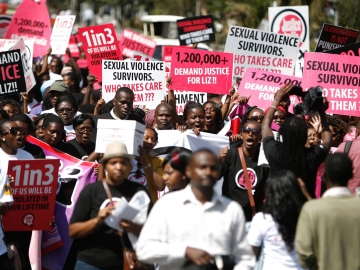
Hundreds of people take to the streets in Nairobi, Kenya, on Thursday, calling for justice for a 16-year-old woman dubbed "Liz" who was gang-raped by six young men in rural Kenya. The men were caught by the police and let go after their punishment cutting the grass at the local police station.

Hundreds of people take to the streets in Nairobi, Kenya, on Thursday, calling for justice for a 16-year-old woman dubbed "Liz" who was gang-raped by six young men in rural Kenya. The men were caught by the police and let go after their punishment cutting the grass at the local police station.


The gang-rape of a 16-year-old Kenyan schoolgirl and the lack of punishment given to the alleged rapists has sparked outrage in the country and beyond.

The attack was so violent it left the girl in a wheelchair with a severe back injury. She identified some of her attackers, who police apprehended only to let go after they were ordered to cut the lawn at the police station.


Several hundred marchers stopped traffic on Nairobi's Central Kenyatta Street on Thursday morning, carrying cardboard boxes representing the more than 1.2 million online signatures on a petition called "Justice for Liz." Liz is a pseudonym for the victim, who lives in Busia County.


Ngozi Nwosu, an activist from Nigeria joining the march, says she was struck by how many Kenyan men were marching.


"There are men joining women to speak against rape," she says. "In Nigeria, women are most likely [to] stand alone. Kenya is doing well in terms of standing up against injustice."


In Kenya, where most rapes go unnoticed and unreported, this case has struck a chord.


"I think everything about this case was so outrageous," says Nebila Abdulmelik, who wrote the petition, calling for the rapists to be arrested and the police officers disciplined.


'Emboldens Others To Also Rape'


On June 24, Liz was walking home from her grandfather's funeral, when she was ambushed by six men, one age 17, the others 18.


She was beaten, gang-raped and dumped in a pit latrine. But when she identified three of her attackers to the police, their only punishment was to cut grass around the police station.


That, says Abdulmelik, "emboldens others to also rape."


The case lay idle for months. Liz's mother had to lease the family farm to afford the hospital. Then a newspaper reporter picked up the story; the activism that followed showcased a Kenya that is increasingly wired and middle class. Kenyans used Twitter and Facebook to bring media attention to the case. Ordinary Kenyans donated thousands of dollars through mobile money-transfer campaigns to pay for Liz's care.


Doctors say Liz will be able to walk again next month, thanks to back surgery. That's not enough, though, says Saida Ali, executive director of the Kenya-based Coalition on Violence Against Women.


"What we are demanding for is justice," she says. "So it's very good that people step in and give money; however, the police still need to make an arrest. The prosecution and eventual punishment need to happen."


A Potential Clash Of Two Kenyas


Ali paints a picture of two Kenyas: one where enough people have the education and means to help a girl like Liz, and the other that is rife with corrupt institutions that she says are shielding the perpetrators.


Kenya has strict sexual violence laws. Marcher Ruth Ojiambo Ocheing, executive director of Isis Wicce in Uganda, says these kinds of laws, pushed by Western governments, are on the books in many African countries but they mean nothing.


"They have now known that the West believes so much in those laws, so it's very easy for us to go and do all the signing, but it stops on the shelves," she says.


On Thursday, marchers tried to take those laws off the shelves with a dose of public shame. They hanged placards and underwear on the spiked metal gates of police headquarters. The police inspector general's chief of staff, William Thwere, came to the gates to take the petition. He said police were searching for the perpetrators, who had gone into hiding, and he promised to discipline officers if they were found to have committed wrongdoing.


But Saida Ali of the Coalition on Violence Against Women says the longer this investigation drags on, the more she fears some police in Busia County could try to pressure Liz into recanting her story


"It raises concerns around security for Liz and her mother and intimidation can take different forms," she says.


Her biggest fear is a clash of those two Kenyas: in which a brazen public protest in Nairobi puts Liz and her mother in rural Kenya in real danger.


Copyright 2013 NPR. To see more, visit http://www.npr.org/.


Kenyan president's trial at ICC postponed

africatodayonline.blogspot.com -
By MIKE CORDER and EDITH M. LEDERER

Associated Press

THE HAGUE, Netherlands (AP) - The International Criminal Court on Thursday postponed the trial of Kenya's president on crimes against humanity charges until February, but the African Union said that's not enough time and stepped up pressure for a one-year deferral.


The judges made the announcement while an AU ministerial delegation was meeting behind closed doors with members of the U.N. Security Council in New York to press the case for the yearlong deferral of the trials of President Uhuru Kenyatta and Deputy President William Ruto on the ground that the stability of Kenya is at stake.


An AU letter on Oct. 12 requesting a deferral said the delay would give Kenya time to beef up counterterrorism efforts in the country and East Africa.


Ethiopia's foreign minister, Tedros Adhanom Ghebreyesus, who led the AU delegation, told reporters afterward that African council members would introduce a resolution in the Security Council "very soon" that would authorize a one-year delay.


He acknowledged divisions in the council, saying: "There are those who support, those who have some difficulties with it."


But the AU hopes members will recognize the "grave" and "extraordinary situation" in Kenya, which has been the target of terrorists and is involved in Somalia, where al-Qaida-linked terrorist groups are active, he said.


Agshin Mehdiyev, Azerbaijan's U.N. ambassador and the current Security Council president, called the meeting "very interesting and very useful," but said there was no outcome yet because it was just an informal discussion.


International Criminal Court judges said Kenyatta's trial, which had been scheduled to start Nov. 12, will now begin Feb. 5. They expressed deep regret at the latest delay in the long-running preparations of the case.


Hours earlier, prosecutors said they would not oppose a delay because they needed time to investigate undisclosed issues raised by Kenyatta's defense attorneys.


The ICC charged Kenyatta and Ruto with crimes against humanity, including murder, forcible population transfer and persecution, for their alleged roles in postelection violence that left more than 1,000 people dead in late 2007 and early 2008. Kenyatta also is accused of responsibility for rape and other inhumane acts carried out by a criminal gang known as the Mungiki, which were allegedly under his control.


Kenyatta - who was elected president earlier this year, even though he had been indicted by the ICC - insists he is innocent, as does Ruto, whose trial is already underway. Kenyatta's lawyers have called for the case against him to be delayed or dropped, saying the evidence is tainted by false testimony from prosecution witnesses.


Pressure for a deferral has intensified following last month's deadly terror attack by militants on a Nairobi mall, which underscored the country's strategic importance in eastern Africa.


Under the Rome statute that created the world's first permanent war crimes tribunal, the U.N. Security Council can defer a case for a year. It has never used that power.


Ethiopia's Ghebreyesus stressed to reporters that a three-month delay in Kenyatta's trial "doesn't help."


"We don't want another unstable country in our region because of lack of focus on its leadership," he said. "The Horn of Africa is most volatile. ...To distract a sitting leader in the name of trial could actually have consequences."


Ghebreyesus said a yearlong deferral would give the AU time to engage the court, the 122 countries that are parties to the ICC who will be meeting in The Hague on Nov. 20, and the Security Council.


"By asking for deferral we are not supporting impunity. We say zero tolerance to impunity," he said. "But whatever decision we make should really be based on the situation on the ground, something that can strike balance between justice, peace and security."


Judges urged prosecution and defense attorneys to speed up their preparations to avoid further postponements. Rights groups also urged speed.


Richard Dicker, director of international justice at Human Rights Watch, called the delay "a double-edged development."


On one hand, it allows a few months for "tempers and threats" to hopefully cool, he said, but it also creates time in which witnesses could be intimidated, something that already has led to some deciding not to testify.


"I think it's imperative for the Kenyan authorities to commit to seeing all witness intimidation cease and desist immediately," he said.


African countries accuse the ICC of disproportionately targeting African leaders. The court has indicted only Africans so far, though half of the eight cases it is prosecuting were referred by African governments.


____


Lederer reported from the United Nations.


Copyright 2013 The Associated Press. All rights reserved. This material may not be published, broadcast, rewritten or redistributed.


Kenya crackdown on militants troubles Muslims

africatodayonline.blogspot.com -

MOMBASA: A Kenyan police crackdown on Islamists is fueling Muslim resentment and moderate preachers say it undermines their efforts to counter recruiting by Al-Qaeda militants with links across the border in Somalia.


Smashing Islamist recruitment networks among its Muslim minority has become a priority for Kenya, however, as it tries to end attacks by Somali militants bent on punishing it for sending troops over the frontier to fight Al-Shabab rebels.


The cost of failure was laid bare in September when Al-Shabab gunmen, one of whom police say is a Kenyan from the port of Mombasa, raided the Westgate shopping mall in the Kenyan capital Nairobi. At least 67 people were killed.


Police say their tough approach, taken before Westgate but stepped up since, has limited the flow of would-be jihadists in and out of Somalia, citing a drop in the number of suspected militants they have tracked and arrested in the past year.


But Islamists, former militant sympathisers, independent security experts and diplomats, some of whom acknowledge short-term benefits from the police actions, say sweeping detentions and perceptions police are carrying out extra-judicial killings have fueled Muslim resentment in the mostly Christian nation.


Police deny accusations of running anti-Muslim hit squads.


Moderate imams, particularly along the coast where most Kenyan Muslims live, have been attacked by Islamist radicals and some say they have been cowed into silence as a result.


Police tactics “are benefiting Al-Shabab more than they are benefiting the government,” said Akullah Khamis, a 33-year-old Muslim in Mombasa, Kenya’s second city. He works with young people and non-governmental agencies and says he himself fended off a bid by Al-Shabaab to enlist his support three years ago.


Kenya’s battle against militancy is seen as vital to the stability of east Africa’s biggest economy, the gateway for regional trade and with a long coastline that has become a transit route for would-be jihadists trained in Somalia.


The United States, Britain and Israel, which fret about the reach of Africa’s Al-Qaeda-aligned Islamists, have trained and equipped Kenya’s anti-terrorism police and intelligence forces.


Mombasa county police commander Robert Kitur dismissed suggestions the force was being heavy handed or targeting the wider Muslim community: “We have never been brutal,” he told Reuters. “People shouldn’t generalise this is about Muslims.”


“These are not Muslims, these are hooligans. We are going to deal with these people ruthlessly. We are just applying force when it is necessary.”


However, one man accused by Western governments of aiding the militants believes widespread arrests, along with raids on mosques and the deaths of people during clashes with police, are helping al Shabaab recruiters.


“This being done to Muslims opens the eyes of the youth to Al-Shabab being right,” Abubakar Shariff, accused by the U.N. Security Council and the United States of raising funds and recruiting for Al-Shabab, told Reuters at his Mombasa home.


Shariff, whose assets have been frozen by Western powers, denies the charges against him.


There is also new friction between majority Christians and Muslims, something that historically has been rare. Muslims, who make up about a tenth of Kenya’s 40 million people, also complain of economic disadvantage in their coastal heartland compared to more prosperous central areas around the capital.


On Oct. 4, Muslim youths burned a Mombasa church after Islamist preacher Sheikh Ibrahim Omar died in a drive-by shooting – an attack some Muslims blamed on police.


Omar’s mentor, Sheikh Aboud Rogo, was shot dead last year in similar circumstances.


Police deny wrongdoing and say they are investigating.


Two Christian pastors have been killed in recent weeks and one group of clergy has asked the government to issue rifles to protect their churches.


Joseph Sigei, police commander in the port of Lamu, near the Somali border, said the flow of suspected militants across the frontier had fallen sharply due to police tactics – only a quarter as many suspects had been detained trying to cross the frontier this year compared to last, he said.


Al-Shabab’s losses in Somalia, where Kenyan and other African troops had driven them out of many cities and towns, had helped turn rebels into informants, Mombasa commander Kitur said, describing part of the police approach.


“[They] helped us with vital information about who, where and when radicalisation was happening,” the commander added.


But regional intelligence and diplomatic sources say recruitment and radicalization of Muslims goes on, albeit more discreetly in light of the police crackdown on Islamists.


One Western diplomat said a small group of “well-organized violent extremists” were able to drive their message home because of the weakness of mainstream Kenyan Muslim leadership. “There is not a good counter-narrative coming from the moderates and moderate leaders,” the diplomat said.


For their part, moderate voices say their work has been undermined because the police make so many ordinary Muslims feel persecuted, fueling suspicion of the authorities.


“Those of us who have stood up to speak against these things are viewed as traitors,” said Hassan Suleiman Mohammad, an imam whom young Muslims threatened to kill as they fought police during riots on Mombasa’s palm-lined avenues on Oct. 4.


Mohammad suspects that radicals who incited youths to roll over his car and jeer him in his mosque during Friday prayers also distributed a CD that named him and dozens of fellow imams as “condemned to burn in hell” for opposing armed jihad.


Many Muslim leaders who support the government – if not police tactics – tread a fine line for fear of reprisals from Al-Shabab and castigation by their communities, said Bryan Kahumbura, an analyst at the International Crisis Group.


“It is especially difficult to aggressively speak out against Al-Shabab down at the coast,” he said of moderate Muslims. “So many people feel the government can’t guarantee their own personal security and safety.”



Four French hostages return home after three years in Al Qaeda captivity

africatodayonline.blogspot.com -

Big News Network.com Wednesday 30th October, 2013


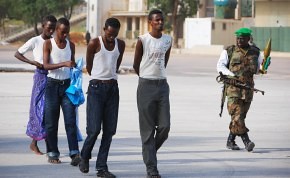
PARIS, France - Four Frenchmen held hostage by Al Qaeda militants for about three years reached their homes in France Wednesday amid speculations that a ransom of $26 million was paid to secure their freedom from the punishing African Sahel.


They were abducted in raids by Al Qaeda linked militants targeting French firms operating uranium mine Sep 16, 2010 and were retrieved in the northern desert of neighbouring Mali on Tuesday.


The four Pierre Legrand, Thierry Dol, Marc Feret and Larribe were working in Arlit, Niger, where the French state-controlled nuclear giant Areva operates a uranium mine.


Al Qaeda in the Islamic Maghreb claimed responsibility for the abduction and later posted videos showing that the men were alive. They were believed to have been kidnapped by Abu Zeid, the militant group's deputy commander, who was killed in an airstrike in Mali this year.


President Francois Hollande greeted each of the hostages on the tarmac at a military airport outside Paris. Emotions ran high when the four landed at the airport. The wife and daughters of Larribe rushed to hug him, and the three held each other as they cried.


Hollande said that it has been "three years of suffering for these citizens, who have been held by jailers without scruples, and three years of suffering for the families who have lived hell and today are relieved".


Foreign Minister Laurent Fabius and Defense Minister Jean-Yves Le Drian had flown to Niger to pick them up. The ministers said the four were freed without a military assault or a ransom being paid.


President Hollande has also said France has ended a policy of paying ransoms for hostages, but suspicion that it still does has been a source of tension with the United States. France brushed off an allegation by a former US diplomat that it paid a $17 million ransom in vain for the release of the hostages abducted in 2010 from Niger.


But an unnamed source, quoted by French newspaper Le Monde, said $26 million was paid to secure the release of the four. The money was extracted from a secret fund operated by the intelligence services.


The global intelligence company Stratfor estimates that Al Qaida in the Islamic Maghreb, or AQIM, has carried out at least 18 kidnappings since 2003, raising an estimated $89 million in ransom payments.


Etihad Airways Suspends Libya Flights

africatodayonline.blogspot.com -

Etihad Airways has suspended flights to Libya's capital, Tripoli, for security reasons, the airline said on Thursday.


"Our assessment of the existing situation at Tripoli airport does not provide the level of assurance we require to ensure safe operation of our flights," the Abu Dhabi-based airline said in a statement.


It did not elaborate.


Libya is facing anarchy as the government struggles to assert control of a country awash with arms and militias two years after the fall of Muammar Gaddafi to a popular uprising.


EB have a battle on hand

africatodayonline.blogspot.com -

Calcutta: After grounding high-flying Bangalore FC in their last match at home, East Bengal will be looking to tame table-toppers Salgaocar when they take on the Goan outfit in an eight round match of the Airtel I-League, in Kalyani on Friday.


East Bengal are currently seven points behind Salgaocar in the ninth place, but have three games in hand. Both teams enjoyed 2-0 wins in their respective seventh round matches. East Bengal beat Bangalore FC in Kalyani while Salgaocar beat United SC at the same venue.


The three points against Bangalore ended East Bengal’s four-game winless streak in Kalyani but they haven’t won back-to-back matches in the I-League since February and will be wary of Salgaocar, who picked up 13 points from a possible 18.


The match will see the return of Uga Okpara in East Bengal defence, while Ryuji Sueoka and Reisangmi Vashum’s injuries will continue to bother them.


East Bengal though have the best goal-scoring ratio in the league so far with South Sudan striker James Moga bagging three in as many games.


East Bengal head coach Marcos Falopa is now looking for some consistency.


“Now that the AFC Cup is over, the I-League is our target. I am happy with the effort of the players so far and have complete faith in each of them,” said the Brazilian.


Salgaocar will be playing their fourth straight away game and coach Derrick Pereira will be satisfied with a return of six points from the previous three matches.


East Bengal also leads the overall head-to-head in the combined history of the National Football League and I-League with 12 wins, 10 draws and 10 defeats in 32 meetings.


Niger says 92 asylum seekers found dead of thirst in Sahara

africatodayonline.blogspot.com -

Posted November 01, 2013 07:10:32


Rescuers have found the bodies of 92 asylum seekers, most of them women and children, strewn across the Sahara desert in northern Niger after their vehicles broke down and they died of thirst, authorities said.


Rescue worker Almoustapha Alhacen said the bodies - 52 children, 33 women and seven men from Niger - were found on the route from the northern mining town of Arlit to the Algerian border.


Many were in an advanced state of decomposition and had been partly devoured by animals, probably jackals, he said.


Northern Niger lies on a major corridor for illegal migration and people-trafficking from sub-Saharan African into north Africa and across the Mediterranean into Europe.


Most of those who make the perilous journey on ancient open-topped trucks are young African men in search of work.


Rescuers said the doomed convoy of women and children was puzzling.


"It's the first time I've seen anything like it," Alhacen said.


"It is hard to understand what these women and children were doing there."


Rescuers found many writing slates in the luggage, suggesting the children may have been students in a Qur'anic school being taken to Algeria, perhaps to beg, Alhacen said.


Alhacen said 19 of the group had reached Algeria by foot and were repatriated to Niger by authorities there.


Two survived after walking dozens of kilometres across the burning desert back to Arlit.


The bodies of 87 of the victims were buried on Wednesday in accordance with Islamic custom, he said.


The migrants had set off in two trucks from Arlit towards Tamanrasset in Algeria some time between late September and mid-October, officials and rescue workers said.


After one truck broke down, the second turned back to look for help but was stranded and the passengers tried to return by foot.


"The search is still going on," the mayor of Arlit, Maouli Abdouramane, said.


Many people flee poverty in Niger, ranked by the United Nations as the least developed country on earth.


Some work in neighbouring Libya and Algeria to save money before returning home.


The networks which send trucks across the desert also attract migrants from across West Africa who dream of a more prosperous life in Europe.


More than 32,000 people have arrived in southern Europe from Africa so far this year.


A crackdown by Spanish authorities has largely closed a route from the West African coast to the Canary Islands which drew tens of thousands of migrants in the mid-2000s.


Instead, most now try to make the Mediterranean crossing from north Africa to southern Europe, many losing their lives when their rickety boats are wrecked.


More than 500 people are believed to have died in two shipwrecks off southern Italy this month.


Reuters


Topics: disasters-and-accidents, immigration, community-and-society, niger